Small Business, Big Dream: How to Turn Your Vision Into Reality
Every entrepreneur knows the feeling. You start with a small business and a big dream, fueled by passion, determination, and the belief that you can build something meaningful. But turning that vision into reality requires more than just ambition. It takes strategy, resilience, and a clear roadmap to success.
Whether you’re just starting out or looking to scale your existing venture, this guide will show you how to transform your small business, big dream mentality into tangible results. Let‘s explore the strategies, stories, and practical steps that will help you achieve the success you’ve been working toward.
Why Every Small Business Starts With a Big Dream
Behind every successful company is a founder who dared to dream bigger than their current circumstances. Your small business didn’t start because you wanted something mediocre. It started because you envisioned something extraordinary.
Big dreams serve as the compass for your small business journey. They give you direction when decisions get tough, motivation when challenges arise, and purpose when the daily grind feels overwhelming. Think about why you started your business in the first place. Maybe you wanted financial freedom, the ability to solve a problem you’re passionate about, or the chance to create jobs in your community.
These dreams aren’t just wishful thinking. They’re the foundation of your business strategy. When you’re clear about your big dream, every decision becomes easier. You can evaluate opportunities by asking, “Does this move me closer to my vision?” This clarity is what separates businesses that thrive from those that merely survive.
The most successful entrepreneurs understand that a small business with a big dream has a competitive advantage. Your vision attracts like-minded customers, talented employees, and valuable partners who believe in what you’re building.
The Challenges Small Businesses Face When Chasing Big Dreams
Let’s be honest: pursuing a big dream with a small business comes with significant obstacles. Understanding these challenges is the first step to overcoming them.
Limited resources top the list. Unlike large corporations with substantial budgets, small business owners often bootstrap their operations, making every dollar count. You might find yourself wearing multiple hats, from CEO to customer service representative, all while trying to maintain quality and grow.
Competition from established players can feel daunting. Larger companies have brand recognition, bigger marketing budgets, and economies of scale that seem impossible to match. It’s easy to feel like your small business, big dream is just a drop in the ocean.
Time constraints present another major hurdle. Building a successful business takes time, and many entrepreneurs struggle to balance growth with daily operations. You’re so busy working in your business that you don’t have time to work on your business.
Cash flow challenges can derail even the best-laid plans. Seasonal fluctuations, delayed payments, or unexpected expenses can create stress and force you to make short-term decisions that don’t align with your long-term vision.
Self-doubt creeps in, especially when progress feels slow. You might question whether your big dream is realistic or if you have what it takes to achieve it. This psychological barrier can be just as limiting as any practical obstacle.
5 Strategies to Scale Your Small Business and Achieve Your Big Dream
Now for the good news: with the right strategies, your small business, big dream can become reality. Here are five proven approaches to accelerate your growth.
Strategy 1: Focus on Your Unique Value Proposition
What makes your business different? Your unique value proposition is your competitive advantage. Instead of trying to compete on price or size, double down on what makes you special. Maybe it’s exceptional customer service, a niche expertise, or a innovative product feature. Identify what you do better than anyone else and make it central to your brand.
Strategy 2: Build Strategic Partnerships
You don’t have to grow alone. Strategic partnerships can give your small business access to resources, customers, and expertise that would otherwise be out of reach. Look for complementary businesses that serve your target audience but aren’t direct competitors. These collaborations can expand your reach without proportionally increasing your costs.
Strategy 3: Invest in Marketing That Works
Many small business owners waste money on marketing that doesn’t deliver results. Instead, focus on channels where your ideal customers spend time. For most businesses today, this means a strong digital presence including a well-optimized website, social media engagement, and content marketing. Track your results meticulously and invest more in what works.
Strategy 4: Systematize and Delegate
To scale your small business, you need to work yourself out of the day-to-day operations. Document your processes, create systems, and delegate tasks that don’t require your personal expertise. This frees you to focus on strategic decisions that move you closer to your big dream.
Strategy 5: Prioritize Customer Experience
Your existing customers are your most valuable asset. It’s cheaper to keep a customer than acquire a new one, and satisfied customers become your best marketers through word-of-mouth referrals. Invest in creating exceptional experiences that turn one-time buyers into loyal advocates.
Real Stories: Small Businesses That Turned Big Dreams Into Success
Nothing inspires quite like real-world examples of entrepreneurs who started with a small business, big dream and made it happen.
Consider the story of Warby Parker. Founded by four business school friends who wanted to disrupt the eyewear industry, they started by selling glasses online from their apartment. Their big dream was to provide affordable, stylish eyewear while giving back through their “Buy a Pair, Give a Pair” program. Today, they’re valued at over $3 billion and have helped millions of people see clearly.
Or look at Spanx founder Sara Blakely, who started with $5,000 in savings and an idea for better-fitting undergarments. She faced countless rejections from manufacturers and retailers, but her persistence paid off. Her small business, big dream approach turned Spanx into a billion-dollar company, making Blakely one of the world’s youngest self-made female billionaires.
Then there’s Patagonia, which began as a small company making climbing equipment. Founder Yvon Chouinard’s big dream wasn’t just profit—it was building a business that prioritized environmental responsibility. Today, Patagonia is a global brand known for its commitment to sustainability, proving that purpose-driven small businesses can compete with anyone.
These stories share common threads: clarity of vision, persistence through obstacles, customer focus, and staying true to core values. Your small business, big dream story could be next.
Common Mistakes Small Business Owners Make (And How to Avoid Them)
Even the most passionate entrepreneurs make mistakes that slow their progress. Here are the most common pitfalls and how to avoid them.
Mistake 1: Trying to Do Everything Yourself
Many small business owners fall into the “solopreneur trap,” believing they must handle every aspect of their business. This leads to burnout and limits growth. Solution: Identify your zone of genius and delegate or outsource everything else. Virtual assistants, freelancers, and automation tools are more affordable than ever.
Mistake 2: Neglecting Financial Management
Poor cash flow management kills more small businesses than competition. Solution: Implement proper bookkeeping from day one, understand your numbers, and maintain a cash reserve for unexpected expenses. Consider working with an accountant or using financial management software.
Mistake 3: Undervaluing Your Products or Services
Competing on price alone is a race to the bottom. When you undercharge, you attract price-sensitive customers and struggle to maintain quality. Solution: Price based on value, not just costs. Position yourself as a premium option in your market and attract customers who appreciate quality.
Mistake 4: Lacking a Clear Marketing Strategy
Posting randomly on social media or running occasional ads isn’t a marketing strategy. Solution: Develop a comprehensive marketing plan that identifies your target audience, defines your message, and outlines specific tactics to reach potential customers consistently.
Mistake 5: Losing Sight of the Big Dream
It’s easy to get caught up in daily operations and lose focus on your ultimate vision. Solution: Schedule regular time for strategic planning. Review your big dream quarterly and ensure your daily actions align with your long-term goals.
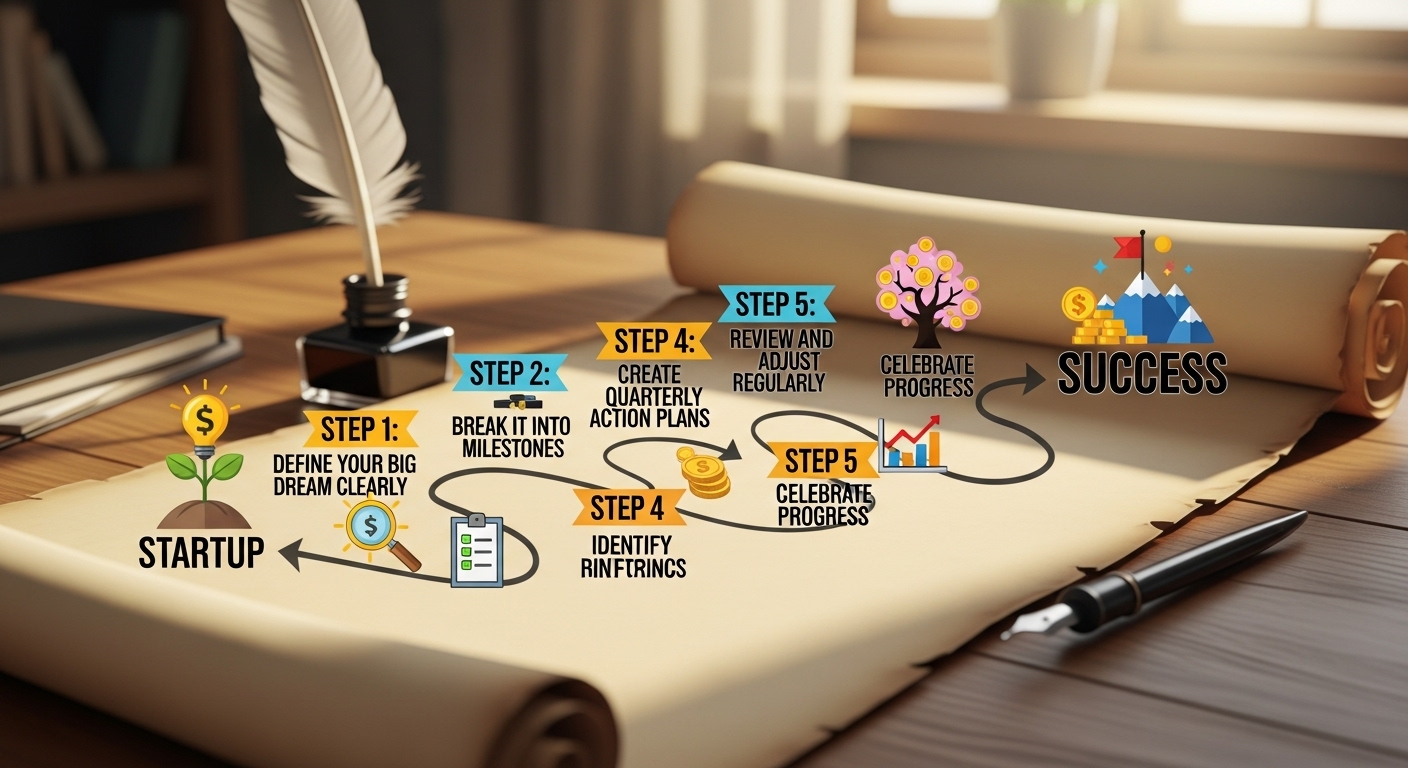
Building a Roadmap: From Small Business to Big Dream Achievement
A dream without a plan is just a wish. Here’s how to create a practical roadmap that connects your current reality to your ultimate vision.
Step 1: Define Your Big Dream Clearly
Get specific about what success looks like. Instead of “I want a successful business,” try “I want to generate $1 million in annual revenue, employ 10 people, and serve 500 customers within five years.” Write it down and make it visible.
Step 2: Break It Into Milestones
Divide your big dream into smaller, achievable milestones. If your five-year goal is $1 million in revenue, what should you achieve in year one? Year two? Each milestone becomes a checkpoint on your journey.
Step 3: Identify Key Metrics
Determine which metrics matter most for your small business. This might include monthly revenue, customer acquisition cost, conversion rates, or profit margins. Track these consistently to measure progress.
Step 4: Create Quarterly Action Plans
Break your annual goals into 90-day sprints. Each quarter, identify three to five key initiatives that will move you closer to your milestones. This makes your big dream feel manageable.
Step 5: Review and Adjust Regularly
Your roadmap isn’t set in stone. Review your progress monthly and adjust your strategy based on what’s working. Flexibility is essential for small businesses navigating changing market conditions.
Step 6: Celebrate Progress
Acknowledge wins along the way, no matter how small. Celebrating milestones keeps you motivated and reminds you that your small business, big dream journey is working.
Tools and Resources Every Small Business Needs to Dream Bigger
The right tools can multiply your effectiveness and accelerate your path to achieving your big dream. Here are essential resources for small business owners.
Financial Management Tools: QuickBooks, FreshBooks, or Wave help you track income, expenses, and profitability. Good financial visibility is non-negotiable for growth.
Project Management Software: Tools like Asana, Trello, or Monday.com keep your team organized and projects on track, essential for scaling operations.
Customer Relationship Management (CRM): HubSpot, Salesforce, or Pipedrive help you manage customer relationships, track sales, and automate follow-ups.
Marketing Platforms: Mailchimp for email marketing, Canva for design, Hootsuite for social media management, and Google Analytics for website insights give you professional marketing capabilities on a small business budget.
Learning Resources: Invest in your own development through platforms like Coursera, LinkedIn Learning, or industry-specific training programs. Your growth as a leader directly impacts your business growth.
Mentorship and Networking: Join local business organizations, online communities, or find a mentor who’s achieved what you’re working toward. Learning from others’ experiences saves time and money.
Automation Tools: Zapier connects your apps and automates repetitive tasks, while tools like Calendly streamline scheduling. Automation gives your small business, big dream operation the efficiency of a larger company.
Your Small Business, Big Dream Journey Starts Today
Here’s the truth: your big dream won’t achieve itself. It requires action, starting right now.
You don’t need to have everything figured out. You don’t need unlimited resources or perfect conditions. What you need is the courage to take the next step, whatever that looks like for your small business.
Maybe today’s step is refining your business plan. Maybe it’s reaching out to a potential partner, investing in that marketing campaign you’ve been considering, or finally hiring help for tasks that drain your energy. Whatever it is, do it today.
Remember, every successful business you admire started exactly where you are now—with a small business, big dream and an entrepreneur willing to pursue it. The difference between those who achieve their dreams and those who don’t isn’t talent or luck. It’s persistence, strategic thinking, and the willingness to keep moving forward despite obstacles.
Your vision matters. Your business has the potential to create value, solve problems, and make a difference in people’s lives. The world needs what you’re building, even if it doesn’t know it yet.
So take that first step today. Refine your vision, implement one strategy from this guide, or simply recommit to your big dream with renewed energy. Your small business, big dream journey is uniquely yours, and it starts the moment you decide it does.