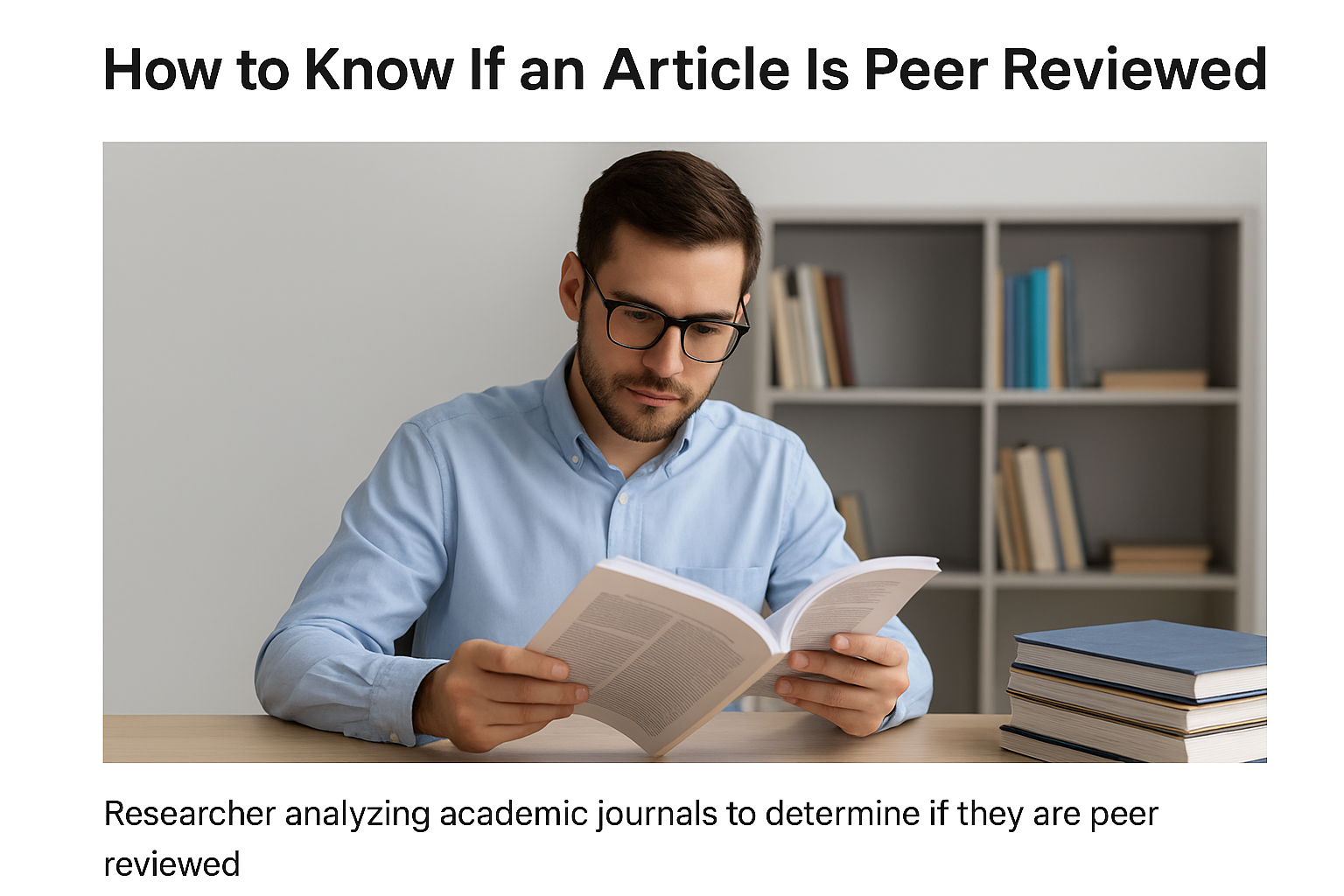
How to Know If an Article Is Peer Reviewed: A Complete Guide
Introduction
Knowing how to know if an article is peer reviewed is essential for anyone who wants to use credible, high-quality information in their research or writing. Peer-reviewed articles are evaluated by experts before publication, ensuring that the content is accurate, unbiased, and supported by solid evidence.
In today’s digital age, where anyone can publish information online, being able to recognize peer-reviewed sources helps you separate reliable research from opinion or misinformation. This guide will walk you through the meaning of peer review, why it matters, and how to easily check whether an article has gone through this rigorous process.
What Is a Peer-Reviewed Article?
A peer-reviewed article is a type of scholarly paper that has undergone a rigorous evaluation process by experts in the same field before it gets published. This process, known as peer review, is essential for ensuring the quality, accuracy, and reliability of academic research.
When researchers conduct studies or write articles, they submit their work to reputable journals. These journals send the article to other specialists—peers—who carefully examine the methodology, data, conclusions, and overall contribution of the work. The reviewers assess if the research meets scientific standards, if the findings are valid, and if the article is suitable for publication.
Only after passing this critical review process does the article get published as a peer-reviewed article. This validation process helps maintain high standards within academic communities and assures readers that the information is credible and thoroughly vetted.
Why It’s Important to Use Peer-Reviewed Articles
When learning how to know if an article is peer reviewed, it’s equally important to understand why peer-reviewed articles matter in the first place. These sources are trusted because they go through a strict evaluation process by experts in the same field before being published.
1. Ensures Credibility and Accuracy
Peer-reviewed articles are reviewed by qualified scholars who check the author’s research methods, data accuracy, and conclusions. This process helps eliminate errors and biases, ensuring the information is reliable and trustworthy.
2. Builds a Strong Foundation for Your Research
Using peer-reviewed sources strengthens your own work. Whether you’re writing a college paper, conducting professional research, or publishing online content, citing peer-reviewed studies shows that your arguments are backed by credible evidence.
3. Promotes Academic Integrity
When you rely on peer-reviewed materials, you demonstrate academic honesty and responsibility. It shows that your research is based on verified knowledge rather than opinion-based or unverified sources.
4. Helps You Stay Updated With Reliable Information
Peer-reviewed journals often publish the most recent findings in various disciplines. Reading these articles keeps you informed about new discoveries, emerging trends, and reputable studies in your field.
5. Increases the Quality of Your Work
High-quality information leads to high-quality research. By using peer-reviewed sources, you improve the depth, reliability, and professionalism of your writing or projects.
Step-by-Step Guide: How to Check If an Article Is Peer Reviewed
If you’re trying to learn how to know if an article is peer reviewed, following a clear process can save you time and ensure you’re using reliable sources. Here’s a simple, step-by-step guide to help you verify whether an article has gone through the peer review process.
Step 1: Identify the Journal Name
Start by locating the name of the journal where the article was published. This information is usually found at the top or bottom of the first page, near the article title.
Step 2: Visit the Journal’s Website
Go to the official website of the journal. Most academic journals clearly state whether they are peer reviewed (sometimes called refereed). Look for sections like “About,” “Editorial Policy,” or “Submission Guidelines.”
Step 3: Use a Database Filter
If you found the article through a research database (like Google Scholar, JSTOR, PubMed, or EBSCOhost), use the filter options. Many databases have checkboxes or tags that let you limit your search results to peer-reviewed journals only.
Step 4: Check the Article’s Structure and References
Peer-reviewed articles often follow a formal structure, including an abstract, introduction, methodology, results, and discussion. They also contain a detailed reference list citing previous academic studies. If an article lacks these elements, it may not be peer reviewed.
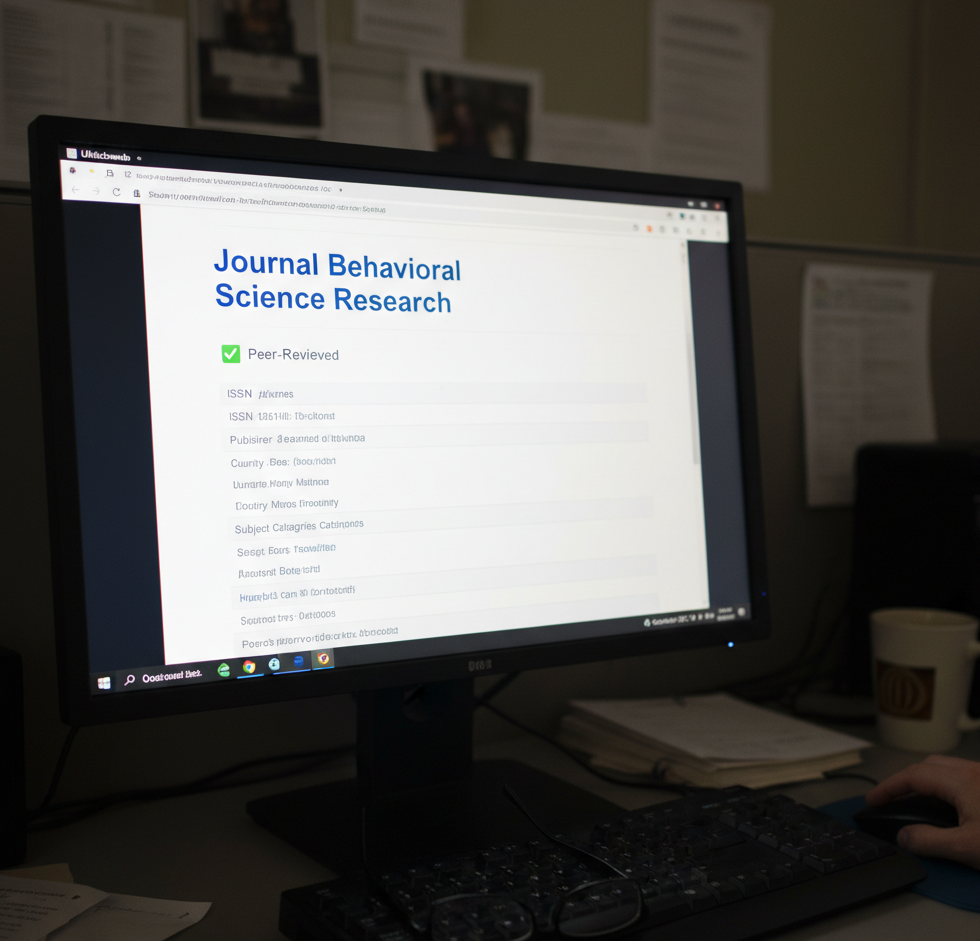
Step 5: Look Up the Journal in Ulrichsweb or Similar Tools
Tools like Ulrichsweb, Scopus, or Directory of Open Access Journals (DOAJ) can confirm whether a publication is peer reviewed. Simply search the journal title, and you’ll see its status listed as “refereed” if it uses a peer review process.
Step 6: Ask a Librarian or Instructor
If you’re unsure, don’t hesitate to ask your librarian, professor, or research advisor. They can quickly verify whether a source meets peer-reviewed standards and even recommend trusted journals in your field.
Step 7: Double-Check Before Citing
Finally, always double-check the journal’s information before citing an article in your paper. Using only peer-reviewed sources strengthens the accuracy and credibility of your work.
Key Differences Between Peer-Reviewed and Non–Peer-Reviewed Articles
When learning how to know if an article is peer reviewed, it helps to understand what makes peer-reviewed articles different from non–peer-reviewed ones. Although both types of content can be useful, they serve different purposes and have different levels of credibility.
1. Review Process
Peer-Reviewed Articles:
Before publication, these articles are evaluated by experts in the same field. The reviewers check the research methods, data accuracy, and conclusions to ensure the work meets academic standards.
Non–Peer-Reviewed Articles:
These are often reviewed only by editors, not subject experts. The review focuses on readability or relevance rather than research quality.
2. Purpose and Audience
Peer-Reviewed:
Written for scholars, researchers, and students who need detailed, evidence-based information.
Non–Peer-Reviewed:
Written for a general audience. Examples include news articles, blog posts, and magazine features.
3. Structure and References
Peer-Reviewed:
These articles follow a formal format—typically including an abstract, introduction, methodology, results, discussion, and references. The citations come from credible academic sources.
Non–Peer-Reviewed:
Usually less structured. They may include opinions, summaries, or commentary without in-depth data or citations.
4. Source Credibility
Peer-Reviewed:
Highly credible because they undergo a strict vetting process. Universities, libraries, and researchers rely on them for accurate information.
Non–Peer-Reviewed:
Can be informative but not always verified. They’re best used for background context or general understanding—not for academic research.
5. Examples
- Peer-Reviewed: Articles from journals like Nature, The Lancet, or Journal of Applied Psychology.
- Non–Peer-Reviewed: Articles from sources like Time Magazine, The Conversation, or personal blogs
| Feature | Peer-Reviewed Articles | Non–Peer-Reviewed Articles |
|---|---|---|
| Reviewed By | Experts in the field | Editors or writers |
| Purpose | Academic research | General information |
| Structure | Formal and detailed | Flexible and informal |
| Citations | Extensive references | Minimal or none |
| Reliability | High | Moderate to low |
Tools and Resources to Verify Peer Review Status
When researching how to know if an article is peer reviewed, it’s helpful to use reliable tools and databases that make the process quick and accurate. These resources can confirm whether a journal or article has undergone peer review, saving you time and ensuring you use credible sources in your work.
1. Ulrichsweb: Global Serials Directory
Ulrichsweb is one of the most trusted tools for checking journal information. By entering the journal title, you can see whether it’s marked as “Refereed,” which means it’s peer reviewed.
2. Directory of Open Access Journals (DOAJ)
The DOAJ lists high-quality, peer-reviewed open-access journals from around the world. If a journal appears in DOAJ, you can be confident it follows a recognized peer-review process.
3. PubMed
For medical and life sciences research, PubMed is an essential database. Most articles indexed in PubMed come from reputable, peer-reviewed journals. You can also check each article’s record for publisher information and review policies.
4. Google Scholar
While Google Scholar itself doesn’t label articles as peer reviewed, it’s still a great starting point. After finding an article, you can check the journal’s website to confirm whether it uses peer review.
5. Scopus and Web of Science
Both Scopus and Web of Science index reputable academic journals across multiple disciplines. These platforms only include peer-reviewed content, so anything you find there can generally be trusted as scholarly.
6. Library Databases (EBSCOhost, ProQuest, JSTOR)
Most university and institutional libraries provide access to databases like EBSCOhost, ProQuest, and JSTOR. These platforms have filters that allow you to limit your search results to peer-reviewed articles only.
7. Journal Websites and Editorial Policies
If you can’t find information through databases, visit the journal’s official website. Look for sections like “About,” “Editorial Board,” or “Submission Guidelines.” These usually describe whether submitted manuscripts go through peer review before publication.
8. University Librarians and Research Guides
Don’t underestimate your university library staff. Librarians are trained to help you identify and access peer-reviewed materials, and many schools have online research guides that explain the process step-by-step.
Tips for Evaluating Research Articles
Learning how to know if an article is peer reviewed is only part of the process. Once you’ve confirmed that a source is peer reviewed, the next step is to evaluate the article’s overall quality and reliability. Not all peer-reviewed articles are equally strong—some may have outdated data or weak analysis. The tips below will help you critically assess research articles for credibility and usefulness.
1. Examine the Author’s Credentials
Check who wrote the article and what qualifications they have. Look for authors with relevant academic degrees, institutional affiliations, or professional expertise in the field. Reputable researchers usually provide contact information and institutional email addresses.
2. Review the Publication Date
Reliable research should be current, especially in fields like medicine, technology, and social sciences where new findings emerge rapidly. Older sources can still be useful, but always verify that their conclusions are still valid.
3. Assess the Research Methods
A strong peer-reviewed article clearly explains how the research was conducted. Look for details about data collection, sample size, variables, and analysis methods. Reliable studies use transparent, replicable methodologies.
4. Evaluate the Sources and References
High-quality research cites other credible studies. Review the reference list to see if it includes reputable, peer-reviewed sources. A lack of citations—or reliance on blogs and opinion pieces—is a red flag.
5. Analyze the Results and Conclusions
Strong research presents clear results supported by data. Check if the conclusions are logical and based on evidence rather than personal opinion or speculation. Avoid articles that make broad claims without data to back them up.
6. Watch for Bias
Even peer-reviewed studies can contain bias. Be cautious of research funded by organizations that may benefit from specific results. Always check for disclosure statements that indicate who funded or supported the study.
7. Check for Clarity and Professional Language
Academic articles should use formal, objective, and precise language. If the writing feels overly promotional or opinion-based, it might not meet peer-reviewed standards.
8. Compare with Other Research
To strengthen your understanding, compare the article’s findings with other studies on the same topic. If multiple peer-reviewed sources support similar conclusions, the information is likely reliable.
Conclusion: Making Sure Your Sources Are Peer Reviewed
Understanding how to know if an article is peer reviewed is an essential skill for anyone conducting academic or professional research. Peer-reviewed articles are the backbone of credible scholarship — they ensure that information is accurate, unbiased, and backed by expert evaluation.
By learning to identify peer-reviewed sources, using trusted databases, and evaluating research quality, you can confidently build a foundation of reliable evidence for your papers, projects, or publications.
Whether you’re a student, researcher, or professional, taking the time to verify your sources not only improves the quality of your work but also strengthens your credibility. In today’s information-driven world, knowing how to distinguish verified research from opinion-based content is one of the smartest skills you can have.