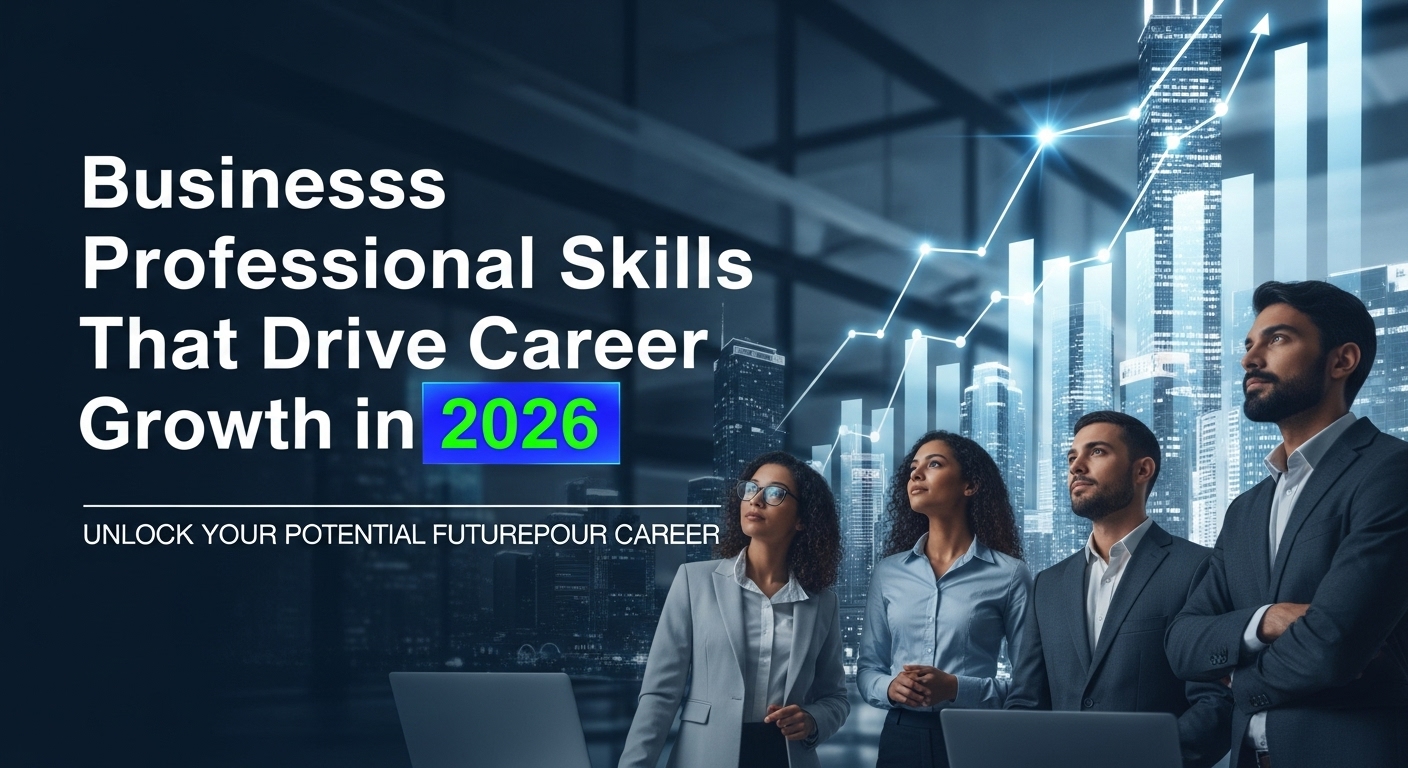
Business Professional Skills That Drive Career Growth in 2026
The business world of 2026 looks fundamentally different from just a few years ago. Artificial intelligence has transformed how we work, remote collaboration has become the norm rather than the exception, and the pace of change has accelerated to levels previously unimaginable. In this rapidly evolving landscape, the skills that define a successful business professional have expanded far beyond traditional competencies.
Whether you’re an emerging leader, a mid-career professional looking to advance, or an executive adapting to new market realities, understanding which skills truly drive career growth has never been more critical. The modern business professional must be a strategic thinker, a technology adopter, an empathetic leader, and a continuous learner—all at once.
This comprehensive guide explores the 12 essential skill categories that separate thriving business professionals from those struggling to keep pace. You’ll discover actionable strategies for developing each competency, comparison frameworks to guide your decisions, and insights into which skills deliver the highest return on investment for your career trajectory. Let’s dive into what it truly takes to excel as a business professional in 2026 and beyond.
1. Communication Excellence: The Foundation of Every Business Professional
Communication remains the cornerstone skill for any business professional, but the methods and mediums have evolved dramatically. Today’s professionals must excel across multiple channels while maintaining clarity, empathy, and impact.
Verbal Communication Mastery
Effective verbal communication in 2026 extends beyond in-person presentations. Virtual meetings, podcast appearances, and video content creation have become standard expectations. Successful business professionals develop the ability to articulate complex ideas clearly, adjust their message for different audiences, and maintain engagement across digital platforms.
Key techniques include strategic storytelling, voice modulation for virtual environments, and the ability to facilitate productive discussions in hybrid settings where some participants are remote and others are in-person.
Written Communication in the Digital Age
The written word carries enormous weight in today’s business environment. From concise Slack messages to comprehensive strategic documents, business professionals must master various writing styles and formats. Email remains critical, but professionals also need skills in creating compelling LinkedIn content, writing persuasive proposals, and crafting clear documentation.
The rise of AI writing assistants means that human writing must focus on authenticity, strategic thinking, and emotional resonance—elements that technology cannot fully replicate.
Active Listening and Emotional Intelligence
Perhaps the most undervalued communication skill is active listening. Top-performing business professionals understand that communication is a two-way street. They practice reflective listening, ask clarifying questions, and demonstrate genuine interest in others’ perspectives.
This connects directly to emotional intelligence—the ability to recognize, understand, and manage both your own emotions and those of others. In virtual environments where non-verbal cues are limited, this skill becomes even more valuable.
Cross-Cultural Communication Skills
Global teams are now standard, making cross-cultural competence essential. Business professionals must navigate different communication styles, time zones, cultural norms, and language barriers. This includes understanding high-context versus low-context cultures, adapting presentation styles, and showing cultural sensitivity in all interactions.
Comparison Table: Traditional vs. Modern Communication Skills
| Aspect | Traditional Communication | Modern Communication |
|---|---|---|
| Primary Medium | Face-to-face, phone calls | Video conferencing, digital platforms |
| Documentation | Formal memos, reports | Collaborative docs, instant messaging |
| Presentation Style | Linear, one-way delivery | Interactive, multimedia engagement |
| Audience Reach | Local/regional | Global, asynchronous |
| Feedback Loop | Delayed, formal | Immediate, continuous |
| Cultural Adaptation | Limited exposure | Constant multicultural interaction |
2. Digital Literacy and Technology Proficiency
In 2026, being a competent business professional is synonymous with being digitally literate. Technology proficiency is no longer the domain of IT specialists—it’s a core requirement for everyone.
Essential Software and Platforms
Every business professional should be comfortable with productivity suites (Microsoft 365, Google Workspace), project management tools (Asana, Monday.com, Notion), communication platforms (Slack, Teams), and customer relationship management systems (Salesforce, HubSpot).
Beyond basic proficiency, professionals should understand how to integrate these tools into seamless workflows that enhance productivity rather than create additional complexity.
AI and Automation Tools Integration
The integration of artificial intelligence into daily business operations represents one of the most significant shifts in recent years. Successful business professionals leverage AI for research, content creation, data analysis, and decision support while maintaining critical thinking about AI-generated outputs.
Tools like ChatGPT, Claude, Midjourney, and industry-specific AI applications have become standard parts of the professional toolkit. Understanding their capabilities, limitations, and ethical implications is crucial.
Data Analytics Fundamentals
You don’t need to be a data scientist, but every business professional should understand how to interpret data visualizations, identify trends, and make data-informed decisions. Basic statistical literacy, understanding of key performance indicators, and the ability to question data quality have become essential skills.
Tools like Excel power features, Tableau, Power BI, and even basic SQL knowledge can significantly enhance a professional’s value and decision-making capability.
Cybersecurity Awareness
With the rise of remote work and cloud-based systems, cybersecurity awareness is no longer optional. Business professionals must understand password management, recognize phishing attempts, implement multi-factor authentication, and follow data protection protocols. A single security breach caused by human error can have catastrophic consequences.
Comparison Table: Must-Have Tech Skills by Industry
| Industry | Critical Technologies | Priority Level | Learning Curve |
|---|---|---|---|
| Finance | Financial modeling software, blockchain basics, algorithmic trading platforms | High | Moderate-High |
| Marketing | Marketing automation, analytics platforms, SEO tools, social media management | High | Moderate |
| Healthcare | EHR systems, telemedicine platforms, health data analytics | High | Moderate-High |
| Manufacturing | Supply chain software, IoT platforms, quality management systems | Medium-High | Moderate |
| Consulting | Business intelligence tools, presentation software, collaboration platforms | High | Low-Moderate |
| Technology | Programming languages, cloud platforms, DevOps tools | Very High | High |
3. Leadership and Team Management Capabilities
Leadership skills distinguish good business professionals from great ones. In 2026, effective leadership means adapting to new work models while maintaining team cohesion and performance.
Leading Remote and Hybrid Teams
The shift to remote and hybrid work models requires fundamentally different leadership approaches. Successful leaders focus on outcomes rather than activity, build trust through transparency, and create intentional opportunities for connection and collaboration.
This includes mastering asynchronous communication, respecting work-life boundaries across time zones, and fostering team culture without relying on physical proximity.
Conflict Resolution Strategies
Conflict is inevitable in any team environment, but how leaders handle it determines team effectiveness. Modern business professionals employ techniques like mediation, active listening to understand root causes, and creating psychological safety where team members feel comfortable expressing disagreement.
The key is addressing conflicts directly but compassionately, focusing on issues rather than personalities, and viewing conflict as an opportunity for growth and innovation.
Delegation and Empowerment Techniques
Effective delegation isn’t about offloading tasks—it’s about empowering team members to grow while ensuring work gets done efficiently. This requires understanding individual strengths, providing clear context and authority, and resisting the urge to micromanage.
Business professionals who master delegation create scalable impact and develop stronger teams in the process.
Building High-Performance Cultures
Culture isn’t created by ping-pong tables and free snacks—it’s built through consistent behaviors, clear values, and deliberate systems. Leaders who create high-performance cultures establish clear expectations, recognize achievements, provide developmental feedback, and model the behaviors they expect from others.
Comparison Table: Management Styles and Their Effectiveness
| Management Style | Best For | Limitations | Effectiveness in 2026 |
|---|---|---|---|
| Authoritative | Crisis situations, clear direction needed | Can stifle creativity and autonomy | Moderate (situational) |
| Democratic | Team collaboration, creative problem-solving | Slower decision-making | High |
| Coaching | Developing team members, long-term growth | Time-intensive, requires skill | Very High |
| Laissez-faire | Highly skilled, self-motivated teams | Can lead to lack of direction | Moderate-High |
| Transformational | Change management, innovation | Requires high emotional intelligence | Very High |
| Servant Leadership | Building trust, empowering teams | May be perceived as weak | High |
4. Strategic Thinking and Problem-Solving
Strategic thinking separates tactical executors from leaders who shape organizational direction. This skill involves seeing the big picture, anticipating future challenges, and making decisions that create long-term value.
Critical Thinking Frameworks
Business professionals employ frameworks like SWOT analysis, Porter’s Five Forces, scenario planning, and first-principles thinking to analyze complex situations systematically. These frameworks provide structure to problem-solving while avoiding cognitive biases.
The best strategists combine analytical frameworks with creative thinking and real-world experience to generate insights others miss.
Decision-Making Methodologies
Quality decisions require balancing data, intuition, speed, and thoroughness. Techniques like decision matrices, cost-benefit analysis, and the Eisenhower Decision Matrix help prioritize and evaluate options objectively.
In 2026’s fast-moving environment, business professionals must also cultivate the judgment to know when to make quick decisions with incomplete information versus when to invest more time in analysis.
Innovation and Creative Problem-Solving
Innovation isn’t just for product designers—every business professional needs creative problem-solving skills. This includes techniques like design thinking, brainstorming methodologies, lateral thinking, and the ability to draw insights from unrelated fields.
Creating space for experimentation, accepting intelligent failures, and challenging assumptions are all critical components of innovative thinking.
Risk Assessment and Mitigation
Every strategic decision involves risk. Skilled business professionals identify potential risks early, quantify their probability and impact, and develop mitigation strategies. This includes understanding different types of risk—market risk, operational risk, reputational risk, and strategic risk.
The goal isn’t to eliminate risk entirely but to take calculated risks that offer appropriate rewards.
Comparison Table: Problem-Solving Approaches for Different Scenarios
| Scenario Type | Recommended Approach | Key Benefit | Time Investment |
|---|---|---|---|
| Urgent Crisis | Rapid response protocols, clear command structure | Speed to action | Low (immediate) |
| Complex Strategic Challenge | Design thinking, scenario planning | Comprehensive solutions | High (weeks-months) |
| Operational Inefficiency | Process mapping, lean methodologies | Systematic improvement | Moderate (days-weeks) |
| Innovation Opportunity | Brainstorming, prototyping, iteration | Creative breakthrough | Moderate-High (weeks) |
| Team Conflict | Mediation, root cause analysis | Relationship preservation | Low-Moderate (hours-days) |
| Market Uncertainty | Data analysis, expert consultation, pilot testing | Informed risk-taking | Moderate (days-weeks) |
5. Adaptability and Continuous Learning
In an era of constant disruption, adaptability isn’t just advantageous—it’s essential for survival. Business professionals who thrive are those who view change as opportunity rather than threat.
Embracing Change in Rapidly Evolving Markets
Markets, technologies, and business models evolve at unprecedented speeds. Successful business professionals stay informed about industry trends, anticipate shifts rather than react to them, and maintain flexibility in their strategies and approaches.
This requires intellectual curiosity, willingness to challenge existing assumptions, and comfort with ambiguity.
Upskilling and Reskilling Strategies
The half-life of skills continues to shrink. Business professionals must commit to continuous learning through online courses, certifications, workshops, reading, and hands-on experimentation. Platforms like Coursera, LinkedIn Learning, and industry-specific programs offer accessible ways to acquire new competencies.
The key is being strategic about which skills to develop based on career goals and market demands.
Learning Agility Assessment
Learning agility—the ability to learn from experience and apply that learning to new situations—has become one of the most valued traits in business professionals. This includes learning from both successes and failures, seeking feedback actively, and transferring knowledge across different contexts.
Self-assessment tools and 360-degree feedback can help professionals understand and improve their learning agility.
Growth Mindset Development
Carol Dweck’s concept of growth mindset versus fixed mindset has profound implications for career success. Business professionals with a growth mindset believe abilities can be developed through dedication and hard work, embrace challenges, persist through obstacles, and view effort as a path to mastery.
Cultivating this mindset involves reframing failures as learning opportunities and focusing on progress rather than perfection.
Comparison Table: Fixed Mindset vs. Growth Mindset in Business
| Aspect | Fixed Mindset | Growth Mindset |
|---|---|---|
| View of Challenges | Avoids challenges as threats to competence | Embraces challenges as opportunities to grow |
| Response to Failure | Views failure as evidence of inadequacy | Views failure as learning opportunity |
| Effort | Sees effort as fruitless if not naturally talented | Sees effort as path to mastery |
| Feedback | Defensive, ignores useful criticism | Values constructive feedback for improvement |
| Success of Others | Threatened by others’ success | Inspired by others’ success |
| Career Trajectory | Plateaus early, limited growth | Continues to improve and advance |
6. Emotional Intelligence (EQ) in the Workplace
While technical skills and intelligence matter, emotional intelligence often determines who advances into leadership and maintains long-term career success.
Self-Awareness and Self-Regulation
Understanding your own emotions, triggers, strengths, and weaknesses is the foundation of emotional intelligence. Self-aware business professionals recognize how their emotions affect their thinking and behavior, and they can regulate their emotional responses appropriately.
Practices like journaling, meditation, and regular self-reflection help develop this critical capability.
Empathy and Social Skills
Empathy—the ability to understand and share the feelings of others—enables business professionals to build stronger relationships, resolve conflicts effectively, and lead with compassion. This goes beyond sympathy to genuinely understanding another person’s perspective and emotional state.
Strong social skills, including the ability to influence, negotiate, and collaborate, flow naturally from empathy.
Managing Workplace Relationships
The quality of professional relationships directly impacts career success. Emotionally intelligent business professionals invest in building trust, maintaining professional networks, navigating organizational politics ethically, and creating value for others.
This includes managing relationships with bosses, peers, subordinates, clients, and stakeholders—each requiring different approaches.
EQ’s Impact on Business Outcomes
Research consistently shows that emotional intelligence correlates with better leadership performance, higher employee engagement, improved customer relationships, and better team collaboration. Organizations increasingly recognize EQ as a critical hiring and promotion criterion.
In 2026’s human-centered business environment, technical skills may get you in the door, but emotional intelligence determines how far you go.
Comparison Table: IQ vs. EQ – Which Matters More?
| Factor | IQ (Cognitive Intelligence) | EQ (Emotional Intelligence) |
|---|---|---|
| Definition | Ability to learn, reason, and solve problems | Ability to understand and manage emotions |
| Measurability | Highly measurable through standardized tests | More subjective, assessed through behavior |
| Development | Relatively stable after young adulthood | Can be significantly developed throughout life |
| Career Impact | Important for technical roles and problem-solving | Critical for leadership and relationship-building |
| Team Dynamics | Contributes individual expertise | Enables team cohesion and collaboration |
| Stress Management | May help analyze stressful situations | Essential for managing emotional responses to stress |
| Long-term Success | Foundation for expertise | Often more predictive of leadership success |
7. Project Management and Organizational Skills
Whether or not you have “project manager” in your title, every business professional manages projects and must organize work effectively.
Time Management Techniques
Effective time management starts with understanding that you can’t manage time—you can only manage yourself and your priorities. Techniques like time blocking, the Pomodoro Technique, batch processing similar tasks, and eliminating time wasters help professionals maximize productivity.
The key is finding systems that work for your personal work style and consistently implementing them.
Prioritization Frameworks
Not all tasks are created equal. The Eisenhower Matrix (urgent/important quadrants), the 80/20 rule (Pareto Principle), and MoSCoW prioritization (Must have, Should have, Could have, Won’t have) help business professionals focus energy on highest-impact activities.
Learning to say no to good opportunities so you can say yes to great ones is a crucial skill.
Project Management Methodologies
Understanding methodologies like Agile, Scrum, Waterfall, Kanban, and Lean helps business professionals choose the right approach for different project types. Agile excels for adaptive projects with evolving requirements, while Waterfall works better for projects with well-defined scopes and sequential phases.
Hybrid approaches that combine elements of multiple methodologies are increasingly common in 2026.
Resource Allocation
Effective resource allocation involves matching the right people to the right tasks, managing budgets efficiently, and ensuring resources are available when needed. This requires understanding team capabilities, anticipating bottlenecks, and making trade-off decisions when resources are constrained.
Comparison Table: Project Management Methods Compared
| Methodology | Best Use Cases | Advantages | Challenges |
|---|---|---|---|
| Waterfall | Projects with clear, stable requirements | Clear structure, comprehensive documentation | Inflexible to changes, late testing |
| Agile | Projects with evolving requirements | Flexible, continuous improvement, early value delivery | Requires cultural shift, less predictability |
| Scrum | Software development, innovative projects | Defined roles, regular feedback loops | Requires commitment, can be rigid |
| Kanban | Continuous workflows, support services | Visual workflow, flexible, continuous delivery | Less structure, requires discipline |
| Lean | Process improvement, efficiency focus | Waste reduction, customer focus | Cultural resistance, requires expertise |
| Hybrid | Complex projects needing multiple approaches | Combines best practices, adaptable | More complex to manage |
8. Financial Acumen and Business Literacy
You don’t need to be an accountant, but every business professional should understand financial fundamentals and how business decisions impact the bottom line.
Understanding Financial Statements
The three core financial statements—income statement (profit and loss), balance sheet, and cash flow statement—tell the story of a business’s financial health. Business professionals should be able to read these documents, understand key metrics, and recognize red flags.
This knowledge enables better decision-making and helps professionals speak the language of senior leadership and investors.
Budgeting and Forecasting
Creating realistic budgets, forecasting future performance, and managing to budget are critical skills. This includes understanding variance analysis (comparing actual versus planned performance) and making adjustments when reality diverges from projections.
Strong budgeting skills demonstrate fiscal responsibility and strategic thinking—qualities valued in promotion decisions.
ROI Calculation and Business Case Development
Every significant business initiative should have a clear business case showing expected return on investment. Business professionals need to quantify benefits, estimate costs, calculate ROI, and present financial justifications persuasively.
This skill is particularly important when competing for limited resources or seeking approval for new initiatives.
Economic Trend Analysis
Understanding macroeconomic factors—interest rates, inflation, market cycles, regulatory changes—helps business professionals anticipate challenges and identify opportunities. This broader perspective enables more sophisticated strategic planning.
Comparison Table: Financial Metrics Every Business Professional Should Track
| Metric | What It Measures | Why It Matters | Ideal Trend |
|---|---|---|---|
| Revenue Growth | Change in sales over time | Business expansion and market success | Upward |
| Profit Margin | Profitability per dollar of sales | Operational efficiency and pricing power | Stable or upward |
| Cash Flow | Actual cash available | Business sustainability and flexibility | Positive |
| Customer Acquisition Cost (CAC) | Cost to acquire new customer | Marketing and sales efficiency | Downward |
| Customer Lifetime Value (CLV) | Total value of customer relationship | Long-term business viability | Upward |
| Return on Investment (ROI) | Efficiency of investments | Decision-making effectiveness | Positive and increasing |
| Debt-to-Equity Ratio | Financial leverage | Financial risk level | Industry-appropriate |
9. Networking and Relationship Building
Your network is one of your most valuable career assets. In 2026, professional success depends heavily on who you know and, more importantly, who knows you.
Professional Networking Strategies
Effective networking isn’t about collecting business cards—it’s about building genuine relationships. This includes attending industry events, participating in professional associations, engaging in online communities, and creating value for others before asking for anything in return.
The best networkers are strategic about whom they connect with while remaining authentic and generous.
Personal Branding Essentials
Your personal brand is what people say about you when you’re not in the room. Business professionals build their brands through consistent expertise demonstration, thought leadership content, professional presence across platforms, and a clear value proposition.
In 2026, this increasingly means having a strong digital presence, particularly on platforms like LinkedIn.
Maintaining Long-Term Business Relationships
Networks require maintenance. Successful business professionals stay in touch with contacts regularly, offer help without expectation of immediate return, celebrate others’ successes, and provide value through introductions, insights, or resources.
Tools like CRM systems can help manage and nurture professional relationships systematically.
Leveraging LinkedIn and Professional Platforms
LinkedIn has become the primary professional networking platform globally. Effective use includes maintaining an optimized profile, sharing valuable content regularly, engaging meaningfully with others’ posts, and participating in relevant groups and conversations.
Other platforms like Twitter (X), Medium, and industry-specific forums also offer networking opportunities depending on your field.
Comparison Table: Networking Tactics – What Works in 2026
| Tactic | Effectiveness | Time Investment | Best For |
|---|---|---|---|
| In-Person Industry Events | High | Moderate-High | Building deep relationships, industry visibility |
| LinkedIn Engagement | Very High | Moderate | Broad reach, thought leadership |
| Professional Associations | High | Moderate | Industry connections, credibility |
| Informational Interviews | High | Moderate | Learning, mentorship, job opportunities |
| Alumni Networks | Moderate-High | Low-Moderate | Trusted connections, diverse industries |
| Online Communities (Slack, Discord) | Moderate-High | Low-Moderate | Niche expertise, real-time collaboration |
| Content Creation (Blogging, Podcasting) | High | High | Thought leadership, scalable networking |
10. Ethical Decision-Making and Corporate Responsibility
In an era of increasing transparency and stakeholder capitalism, ethical leadership and corporate responsibility have moved from nice-to-have to essential.
Business Ethics Frameworks
Ethical decision-making requires frameworks that go beyond legal compliance. Models like the Triple Bottom Line (people, planet, profit), stakeholder theory, and virtue ethics help business professionals navigate complex moral questions.
The key is making decisions you can defend publicly and that align with your values and organizational principles.
Sustainability and ESG Considerations
Environmental, Social, and Governance (ESG) factors have become central to business strategy in 2026. Investors, customers, and employees increasingly demand that companies operate sustainably and responsibly.
Business professionals need to understand climate impact, resource efficiency, social equity, and governance practices—and how these factors affect long-term value creation.
Diversity, Equity, and Inclusion (DEI)
DEI isn’t just morally right—it’s a business imperative. Diverse teams make better decisions, innovation thrives in inclusive environments, and companies with strong DEI practices attract top talent and customers.
Effective business professionals champion diversity, challenge bias, create inclusive environments, and ensure equity in opportunities and outcomes.
Ethical Leadership Principles
Ethical leaders demonstrate integrity consistently, admit mistakes openly, treat all stakeholders fairly, resist short-term pressures that compromise values, and create cultures where ethical behavior is expected and rewarded.
This builds trust—the foundation of all sustainable business relationships.
Comparison Table: Short-term Gains vs. Long-term Ethical Business Practices
| Aspect | Short-term Focus | Long-term Ethical Focus |
|---|---|---|
| Decision Driver | Quarterly results, immediate profit | Sustainable value creation, stakeholder welfare |
| Stakeholder View | Shareholders primarily | All stakeholders (employees, customers, community) |
| Risk Approach | Minimize costs, accept ethical risks | Invest in risk mitigation, ethical safeguards |
| Reputation Impact | Potential for scandals, trust erosion | Brand strength, customer loyalty |
| Talent Attraction | May struggle to attract values-driven talent | Attracts and retains top talent |
| Regulatory Risk | Higher compliance risks | Proactive compliance, industry leadership |
| Long-term Viability | Vulnerable to disruption | Resilient, adaptable, sustainable |
11. Negotiation and Persuasion Skills
Whether negotiating salaries, closing deals, or influencing stakeholders, negotiation and persuasion skills directly impact your career trajectory and business outcomes.
Win-Win Negotiation Strategies
The best negotiations create value for all parties rather than simply dividing a fixed pie. Interest-based negotiation focuses on underlying needs rather than positions, seeks creative solutions that satisfy multiple interests, and builds relationships that enable future collaboration.
Techniques include separating people from problems, focusing on interests not positions, generating options before deciding, and using objective criteria.
Persuasive Communication Techniques
Persuasion combines logical arguments, emotional appeals, and credibility. Effective persuaders understand their audience’s motivations, frame messages in terms of audience benefits, use data and stories strategically, and address objections proactively.
The principles of reciprocity, consistency, social proof, authority, liking, and scarcity (from Robert Cialdini’s research) remain powerful tools in the persuasion toolkit.
Handling Difficult Conversations
Difficult conversations—delivering critical feedback, discussing performance issues, negotiating disagreements—require courage and skill. Best practices include preparing thoroughly, choosing appropriate timing and settings, focusing on specific behaviors rather than character, listening actively to the other perspective, and seeking collaborative solutions.
Avoiding difficult conversations only makes problems worse over time.
Contract and Deal-Making Essentials
Business professionals should understand contract basics, key terms to negotiate, common pitfalls to avoid, and when to involve legal counsel. This includes understanding different contract structures, payment terms, performance metrics, and exit clauses.
Even if you’re not directly negotiating contracts, understanding these elements helps you contribute more effectively to business discussions.
Comparison Table: Competitive vs. Collaborative Negotiation
| Element | Competitive (Win-Lose) | Collaborative (Win-Win) |
|---|---|---|
| Goal | Maximize personal gain | Create mutual value |
| Relationship Focus | Short-term transaction | Long-term partnership |
| Information Sharing | Limited, strategic disclosure | Open, transparent communication |
| Tactics | Pressure, deadlines, limited options | Joint problem-solving, multiple options |
| Outcome | One party typically dissatisfied | Both parties satisfied |
| Future Dealings | May damage relationship | Strengthens relationship |
| Best Application | One-time transactions, competitive markets | Ongoing relationships, complex deals |
12. Industry-Specific Skills and Specialization
While general business skills provide a foundation, deep expertise in your specific industry or function creates differentiation and value.
Identifying Your Niche
Career success often comes from being exceptionally good at something specific rather than mediocre at everything. Identifying your niche involves assessing your strengths and interests, analyzing market demand, finding the intersection of what you’re good at and what’s valued, and committing to deep expertise development.
Your niche should be narrow enough to differentiate you but broad enough to provide career opportunities.
Certifications and Credentials That Matter
Strategic certifications can accelerate career growth by demonstrating expertise, providing structured learning, and opening doors to opportunities. Relevant certifications vary by field—PMP for project management, CFA for finance, SHRM-CP for HR, various cloud certifications for technology roles.
The key is choosing certifications valued in your target market and complementing them with practical experience.
Staying Current with Industry Trends
Industries evolve constantly. Business professionals maintain relevance by reading industry publications, attending conferences, participating in webinars, following thought leaders, and engaging with professional communities.
Dedicating even 30 minutes daily to professional learning compounds into significant expertise over time.
Building Domain Expertise
Deep domain expertise comes from deliberate practice, diverse experiences within your field, learning from experts and mistakes, and continuous application of knowledge. This expertise enables you to see patterns others miss, make better predictions, and provide unique value.
Expertise isn’t built overnight—it requires sustained commitment over years.
Comparison Table: Generalist vs. Specialist Career Paths
| Factor | Generalist Path | Specialist Path |
|---|---|---|
| Career Flexibility | High—can pivot between roles and industries | Lower—expertise is specific |
| Earning Potential | Good, especially in management | Can be very high at expert level |
| Job Security | Moderate—adaptable but less irreplaceable | High in-demand specialties, vulnerable to disruption |
| Career Progression | Often moves into general management | Advances through technical depth, expert roles |
| Learning Approach | Broad knowledge across domains | Deep expertise in narrow domain |
| Market Value | Valued for versatility and leadership | Valued for unique expertise |
| Best For | Those who enjoy variety, management aspiration | Those passionate about specific domains |
The Complete Business Professional Skills Matrix 2026
To help you prioritize your skill development, here’s a comprehensive comparison of all 12 skill categories:
| Skill Category | Importance (1-10) | Difficulty to Master | Time Investment | ROI for Career Growth | Best Learning Resources |
|---|---|---|---|---|---|
| Communication Excellence | 10 | Moderate | 6-12 months | Very High | Toastmasters, Dale Carnegie, writing courses |
| Digital Literacy | 9 | Moderate-High | 3-6 months | Very High | LinkedIn Learning, Coursera, vendor certifications |
| Leadership & Management | 10 | High | 1-3 years | Exceptional | MBA programs, executive coaching, leadership books |
| Strategic Thinking | 9 | High | 1-2 years | Very High | Strategy frameworks, case studies, mentorship |
| Adaptability & Learning | 10 | Moderate | Ongoing | Exceptional | Growth mindset literature, reflection practices |
| Emotional Intelligence | 9 | High | 1-3 years | Very High | EQ assessments, coaching, mindfulness practices |
| Project Management | 8 | Moderate | 6-12 months | High | PMI certification, hands-on projects, tools training |
| Financial Acumen | 8 | Moderate-High | 6-12 months | High | Finance courses, mentorship, practical application |
| Networking | 8 | Moderate | Ongoing | Very High | Industry events, LinkedIn, professional associations |
| Ethics & Responsibility | 7 | Moderate | 3-6 months | High | Ethics frameworks, case studies, organizational culture |
| Negotiation & Persuasion | 8 | Moderate-High | 6-12 months | Very High | Negotiation courses, practice, books (Getting to Yes) |
| Industry Specialization | 9 | High | 2-5 years | Very High | Industry certifications, conferences, hands-on experience |
Frequently Asked Questions
What skills does a business professional need in 2026?
A successful business professional in 2026 needs a combination of timeless skills and modern competencies. The core requirements include excellent communication across digital platforms, technological literacy including AI tools, emotional intelligence, strategic thinking, and adaptability. Additionally, professionals need financial acumen, project management capabilities, strong networking skills, and often industry-specific expertise. The key difference from previous eras is the emphasis on digital fluency, continuous learning, and the ability to lead in hybrid and remote environments.
How can I develop business professional skills quickly?
While deep expertise takes time, you can accelerate skill development through focused strategies: identify your highest-priority skill gaps based on career goals, use online learning platforms for structured education, seek mentorship from experienced professionals, practice skills in real work situations, get feedback regularly, and dedicate consistent time daily to learning. Micro-learning approaches (15-30 minutes daily) are often more effective than sporadic intensive sessions. Additionally, applying new skills immediately in your work reinforces learning and demonstrates value to your organization.
What’s the difference between a business professional and an entrepreneur?
While there’s significant overlap, business professionals typically work within established organizations, focusing on executing strategy, managing teams, and driving results within existing structures. Entrepreneurs create new ventures, assume financial risk, build organizations from scratch, and often disrupt existing markets. That said, modern business professionals increasingly need entrepreneurial mindsets—creativity, risk-taking, innovation—while entrepreneurs need strong business professional skills to scale their ventures. The line between the two continues to blur in 2026’s dynamic business environment.
Which business professional skills are most in-demand?
Current market demand prioritizes digital literacy (especially AI integration), data analysis capabilities, emotional intelligence and leadership, strategic thinking and problem-solving, and adaptability to change. Communication skills remain perpetually valuable. Industry-specific technical expertise also commands premium compensation. The highest-demand skills often sit at intersections—for example, professionals who combine technical expertise with strong communication and leadership abilities are particularly sought after.
How do I know which skills to prioritize?
Prioritize skills based on several factors: your current role requirements and performance gaps, your career aspirations (what skills do people in your target role possess?), market demand in your industry, your natural strengths and interests, and skills with highest ROI for your specific situation. Conduct a skills gap analysis comparing your current capabilities to your target profile. Seek feedback from managers, mentors, and peers about which skills would most accelerate your career. Generally, focus on skills that combine high market demand with alignment to your strengths and goals.
Can I become a successful business professional without a degree?
Yes, though the path may require more intentionality. Many successful business professionals have built careers through alternative routes: certifications and specialized training, hands-on experience and proven results, building a strong portfolio of work, continuous self-directed learning, and strategic networking. In 2026, competency-based hiring is increasing, with many organizations focusing more on demonstrated skills than credentials. That said, some industries and senior positions still heavily favor traditional degrees. The key is building undeniable expertise and a track record of results.
What certifications boost business professional credibility?
Valuable certifications vary by field but commonly respected options include: PMP (Project Management Professional) for project managers, CPA (Certified Public Accountant) for finance professionals, SHRM-CP or PHR for human resources, various technology certifications (AWS, Azure, Google Cloud) for tech professionals, Six Sigma for process improvement, Certified ScrumMaster for Agile environments, and industry-specific certifications for your field. Choose certifications that are recognized in your industry, align